
The largest and most widespread Muslim da’wah (missionary/outreach) movement in the world is generally considered to be Tablighi Jamaat.
Why it is considered the largest:
• 🌍 Global presence: Active in over 150+ countries across Asia, Africa, Europe, and North America.
• 👥 Millions of followers: It does not keep formal membership records, but participation numbers are widely believed to be in the tens of millions.
• 🕌 Grassroots outreach: Focuses on inviting Muslims to practice Islam more closely, mainly through mosque-based activities and small traveling groups (jamaats).
• 🤝 Non-political approach: It avoids politics and concentrates on personal faith, prayer, and religious habits.
Origins:
• Founded in the 1920s in India by Muhammad Ilyas Kandhlawi.
Important note:
• Tablighi Jamaat primarily focuses on revival among Muslims, not conversion of non-Muslims, which distinguishes it from some other da’wah organizations.
Why there’s a difference between them? Like one group follows Nizamuddin, India and others group says they are with Ulema!
The difference you’re referring to is mainly about leadership, decision-making, and authority, not about core Islamic beliefs.
Within Tablighi Jamaat, a division developed in recent years. Here’s a clear, neutral explanation:
⸻
1. The Nizamuddin (India) group
This group is centered around the historic headquarters (Markaz) at
Nizamuddin Markaz in Delhi, India.
• They emphasize central leadership from the Markaz.
• After the death of Muhammad Ilyas Kandhlawi’s successors, leadership became concentrated under
• Followers believe unity comes from one central ameer (leader) guiding the work globally.
⸻
2. The “Shura / Ulema” group
This group emphasizes collective leadership (Shura) rather than one individual.
• “Shura” means consultation — decisions are made by a council of senior scholars (Ulema).
• They argue that after earlier leaders passed away, leadership should remain shared, not centered on one person.
• Many senior scholars in countries like India, Pakistan, and Bangladesh support this structure.
⸻
Why the difference happened
The split is mainly due to:
🔹 Leadership style disagreement
• One leader (Ameer) vs. group consultation (Shura)
🔹 Authority and trust
• Some scholars questioned decisions and authority of a single leader.
• Others believe unity requires one central figure.
🔹 Organizational control
• Who manages global activities, gatherings (Ijtema), and appointments.
⸻
Important point
👉 Both sides:
• Follow the same basic teachings of Islam
• Use the same method of da’wah (6 points, mosque-based outreach, etc.)
• Have the same origin and history
This is not a difference in Aqeedah (core belief) — it’s an administrative and leadership اختلاف (difference).
⸻
Simple way to understand
• Nizamuddin side: “Unity comes from one leader.”
• Shura/Ulema side: “Unity comes from consultation among scholars.”
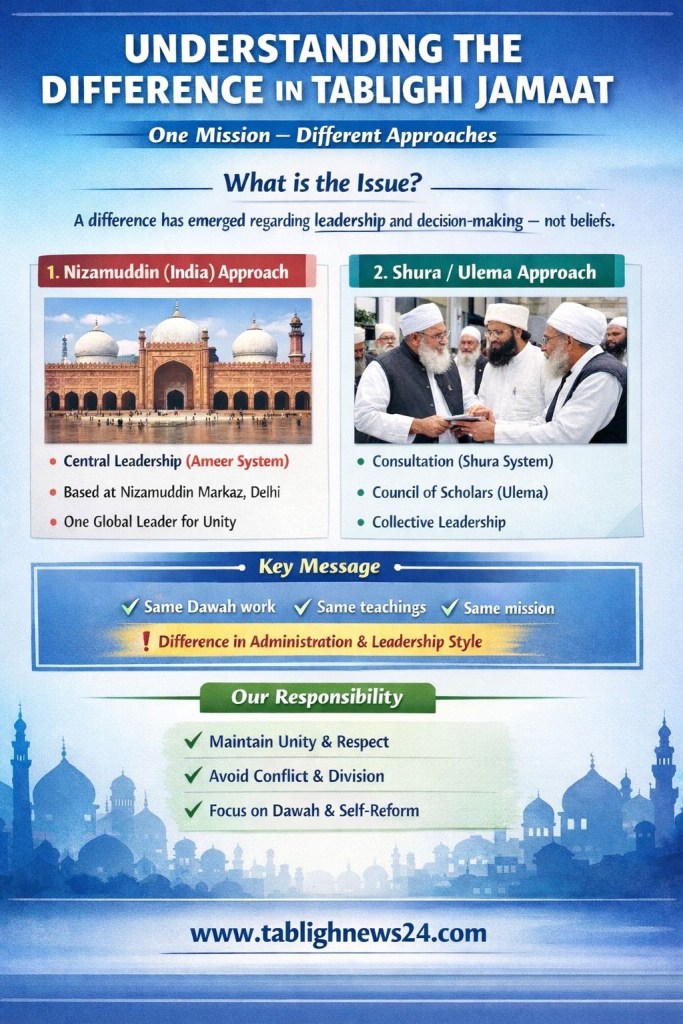
UNDERSTANDING THE DIFFERENCE IN TABLIGHI JAMAAT
One Mission – Different Approaches
What is the Issue?
Within Tablighi Jamaat, a difference has emerged regarding leadership and decision-making — not beliefs.
⸻
1. Nizamuddin (India) Approach
• Follows central leadership (Ameer system)
• Leadership based at Nizamuddin Markaz, Delhi
• Emphasizes one global leader for unity
⸻
2. Shura / Ulema Approach
• Follows consultation (Shura system)
• Decisions made by a council of scholars (Ulema)
• Emphasizes collective leadership
⸻
Key Message
✔ Same Dawah work
✔ Same teachings
✔ Same mission
❗ Difference is only in administration & leadership style
⸻
Our Responsibility
• Maintain unity and respect
• Avoid conflict and division
• Focus on Dawah and self-reform
⸻
“Unity in the Ummah is a mercy.”
 tablighnews24.com